Seville | Snail Season

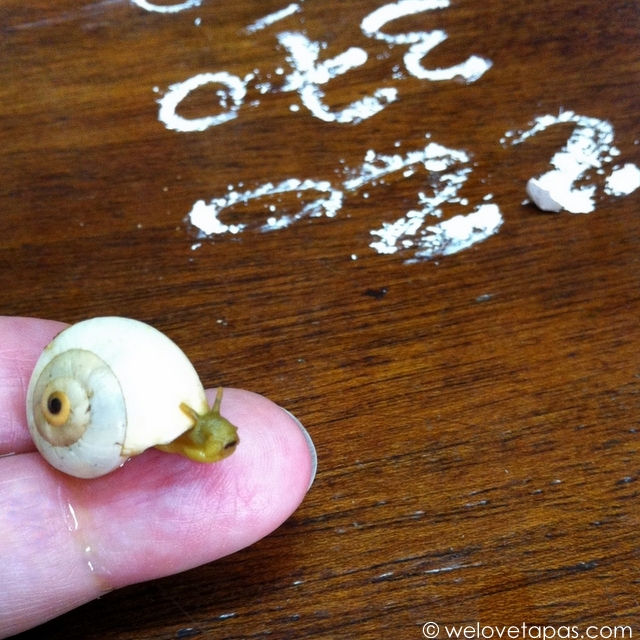
For most English speaking people at least the eating of snails is associated with the French and their escargots, but in fact snails are eaten all around the Mediterranean, and Spain, where they are known as caracoles (the small ones) and cabrillas (the big ones), is no exception. Snail season, which runs through mid-April to late-June, is eagerly awaited, and announced by many bars with a drawing of a snail and “hay caracoles!” (there are snails!).

Caracoles are prepared by cooking them in a broth, usually with garlic and black pepper, and the quality of the broth is generally accepted as central to the quality of the dish served to customers. Cabrillas tend to be cooked in a thicker tomato-based sauce. Bars have their own “secret” recipes, so if you want to enjoy some snails while you are in Seville, knowing where to go is essential. These are 5 of our favourites.


Casa Antonio – Bar Los Caracoles
Perez Galdos, 13
Tel: +34 954 213 172

A small family run bar just off the Plaza Alfalfa, Casa Antonio – Bar Los Caracoles is one of the best for snails served with a side of broth, and also specializes in great fish and seafood tapas.


Bodega La Mina
Cuesta del Rosario, 7
Tel: +34 954 214 092

Another small traditional bar near the centre where you can be assured of a warm welcome and a cold beer or glass of manzanilla. Also famous for its mojama (cured tuna) and chicharrones it’s a great place to start your tapeo.


Casa Ruperto
Santa Cecilia, 2
Tel: +34 954 086 694

Triana, the working class neighbourhood across the river, is famous for almost everything traditionally Sevillano – flamenco, bullfighters, seafood – and snails. Casa Ruperto is a no frills kind of a place but is justly renowned for its snails (also for its quail, but that’s another story).


Casa Diego
Alfarería, 5
Tel: +34 663 520 221

Also in Triana, not far from the market, Casa Diego serves up some great caracoles, which you can enjoy with a chilled manzanilla or a cold beer from their unique beer pump in the form of the nearby Santa Ana Church.


Bar Alfonso – El Rey de Los Caracoles
Santas Patronas, 5
Tel: +34 954 225 960

Alfonso Pérez was dubbed “The King of the Snails” in 1988 and his bar, now run by son Manuel, offers both caracoles and cabrales in season. Both are delicious and can be ordered to eat in or take-away.


Hola!

Postcard from Andalucia | Ronda

Ronda is one of our favourite small towns (population 35,000) in Andalucia, and is already a popular tourist destination. It’s situated in the mountains west of Malaga , between the Sierra de Grazalema and the Sierra de la Nieves, and is considered to be one of the “White Villages” of Andalucia. It can be reached quite easily by car or bus from Seville (about 2 hours) or Malaga.

The origins of modern Ronda go back to Roman times, but it’s during the Moorish era that it had it’s greatest fame and importance, even achieving independence for a time in the 11th century, and being one of the last Moorish strongholds to fall to the Christians (1485). It’s also regarded as the birthplace of modern bullfighting, pioneered by the Romero dynasty of bullfighters in the 18th century, and also (by a whisker) of Spain’s oldest bullring, completed in 1784. Both Ernest Hemingway and Orson Welles were great fans, but nowadays there are only a few days of bullfighting a year, during feria in the first week of September. The rest of the year it’s a major tourist attraction, and is well worth seeing.

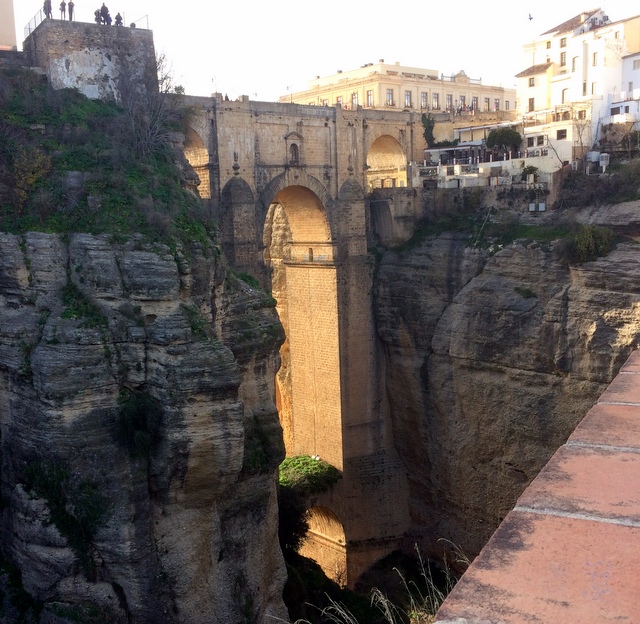
Ronda’s main claim to fame, though, is its stunning hilltop location overlooking the area around – or more precisely two hilltop locations, separated by the Tajo Gorge, a spectacular narrow canyon up to 120 metres deep, with the River Guadalevín running through it. It’s spanned at its highest point by Ronda’s iconic Puente Nuevo (the New Bridge, actually built in the 18th century, but still called new to distinguish it from the older bridges lower down the hill). From here you can look out onto the valley to the west, or down the gorge, with its whitewashed houses perched on the edge, to the Puente Viejo (the Old Bridge, or Arab Bridge, actually built in the Christian era, though there was possibly a previous bridge on the same site) and the Puente Romano (the current structure is relatively modern, but again there are traces of earlier structures at the same place, certainly one from the Moorish period, and possibly from as early as Roman times). Walk down through the Cuenca gardens, visit the Baños Arabes (arab baths), and if you’re feeling fit go down the water mine, a stairway cut through the rock from the upper city down to the river.

At the north end of the bridge is the Christian period new town. As well as the bull ring there is the Alameda de Tajo, a small park at the top of the cliffs with spectacular views, and the churches of La Merced and El Socorro (time permitting).

To the south is La Ciudad, the old city, which has as many interesting things packed into its small area as pretty much anywhere in Spain. Must sees include the old main gate of the city, the Almocabar, with the fortified Church of the Holy Spirit, the old minaret and the central square the Plaza Duquesa de Parcent, where you can find the town hall and the Church of Santa Maria de la Mayor (sometimes referrred to as the cathedral, though it’s not the seat of a bishop). It’s also possible to walk down into the gorge for that classic shot of the New Bridge, and for a closer look at the remains of the old walls and mills. There are also several interesting museums, including the municipal museum in the Casa Mondragon, the House of Don Bosco, a small museum of wine and the Bandits Museum. My favourite, though, is the quirky and eclectic Lara Museum, which you should go and see.

Finally, where should you go to eat? There are plenty of good places, and any list based on the personal opinion of a visitor (even one who’s been a number of times) is necessarily incomplete, but this is my postcard, and this is my short list of places I like. For breakfast, Casa Luciano in the main street of the old town, where I was fortuitously led by a couple of locals on my last visit – great toast and coffee. Another new find was wood grilled meat restaurant El Sacristan, next to the Santa Maria church. Old favourites include La Niña Adela, which is at the top of the new town and a bit difficult to find, but worth the effort, the Almocabar (just outside the gate), and Tragatá, near the New Bridge and bullring.

Finally, a mention for Reservatauro, a bull and horse breeding farm just outside Ronda, where I spent a few fascinating hours learning about fighting bulls and Andalucian horses.

It’s all about the Pig

IMG_9081

As anyone who has been to Spain will already know, when it comes to food the pig holds a special place of affection in the hearts of the Spanish (if you can excuse a rather mixed metaphor). No one knows exactly how long this love affair has been going on, but it’s thought that domesticated pigs were first brought to the peninsula by the Phoenicians nearly three thousand years ago, though the native Iberians had no doubt been hunting the native wild boar for many centuries before that. Although always popular, the centrality of the pig in Spain was cemented in the late Middle Ages as the Christians wrested control from the Moors and the Jews, and the consumption of pork became something of a symbol of the new Christian Spain.

IMG_8821

At some point the boar and the domesticated pigs were crossbred, resulting in the Iberian peninsula’s very own special breed, the famous Iberian black-footed pig. They are raised mainly in the hill country of northwest Andalucia and Extramadura, on a specially maintained landscape called a dehesa, essentially grassland with groves of oak trees, and the pigs fatten by foraging on acorns (Spanish bellota). Although not numerically the majority of Spanish pigs, this is the breed which supplies the unique and highly prized Iberian pork and ham products.

IMG_9206

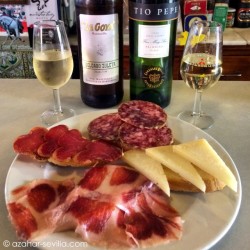
Most prized of all, of course, is the wonderful jamon Iberico Bellota. The combination of breed, free-range diet and the curing process make this the treat not to be missed. Succulent and full of flavour, it is arguably the best ham in the world, and for the full Spanish effect it should be accompanied by a glass of chilled manzanilla or fino. You should also try caña de lomo, a cured Iberian pork loin with a subtly different taste and texture.

IMG_8855

But it’s not all jamon. Traditionally, every part of the pig is used. Lean cuts such as presa or solomillo are normally grilled (solomillo is popular with a whisky sauce with lots of garlic and a hint of lemon that’s absolutely delicious). The slightly fattier pluma and secreto, as well as bacon, may be either grilled or fried. But it doesn’t stop there. Tender stewed pork cheeks (carrillada) seem to be one of Spain’s best kept culinary secrets. So too is morcilla, or blood sausage. The idea can be off-putting to some, but in fact it’s very tasty, and very versatile.

But when I say every part of the pig is used, I mean every part. From tripes (the secret’s in the sauce) to feet and from snout to tail, it’s all part of somebody’s favourite dish. I’ve tried pretty well all of them at one time or another, and haven’t found one that I don’t like. How many are you going to try while you’re here?

IMG_8778

Day Trip to Triana

triana (56)

Typical Triana courtyard

Triana is the neighbourhood of Seville across the river from the old walled city, and is regarded by many Trianeros as a completely separate entity, historically, the home of Gypsies, sailors and other groups from the metaphorical wrong side of the tracks, and it retains something of that atmosphere today, with strong attachments to the cultures of flamenco and bullfighting, together with a certain religious fervour and sentimentality. If you’re in Seville for more than a couple of days and want to get away from the main tourist areas you should take some time to cross “The Bridge” to this near neighbour of the city.

triana (1)

Isabel II bridge

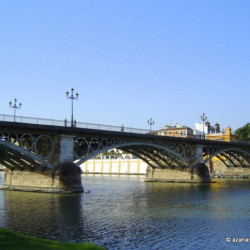
The Bridge is the Isabel II bridge (popularly just called Triana bridge), a wonderful example of mid 19th century iron architecture which replaced the previous “bridge of boats”, built by the Moors in the 12th century. Crossing over you get some fine views along the river, on one side to the old port and the Torre del Oro, with the towers of the Plaza España beyond, as well as the old Moorish dock on the Triana side. In the other direction is the site of the 1992 expo and the Cartuja monastery.

triana (8)

Calle Betis from Plaza Altozano

The square immediately across the bridge, the Plaza Altozano, and the buildings around it, are still the hub of “old” Triana. The Restaurante El Faro on the left, beside the steps going down to Calle Betis, is an unmissable landmark. Much prettier, though, is the Carmen Chapel opposite, designed by Anibal Gonzalez in preparation for the 1929 Spanish American exhibition, with its brickwork and colourful tiles.

Before you begin exploring, grab a little breakfast at Manu Jara, a little French style patisserie on Calle Pureza with a tempting selection of croissants and pastries, as well as the obligatory coffee. Just opposite you can also find the Antigua Abacería, a traditional style pit stop that’s also worth a visit to whet your appetite.

triana (21)

Triana market stall

Then it’s back to the main square for a visit to Triana market, a must see for anyone with an interest in local food culture. With its old ceramic tile nameplates it’s probably the prettiest of Seville’s markets, as well as having all the traditional market produce, from colourful fruit and veg to fresh fish, hams, sausages, game, wonderful cheeses, and olives, beans and spices. There are also a number of market bars, both traditional and “gourmet”, including an oyster and sushi bar, and a microbrewery, which give you a good opportunity for a spot of refreshment and people watching.

triana (29)

Inquisition Alley

Beneath the market is a reminder of the Dark Side of Spain’s past, the Castillo San Jorge. Originally built to guard and defend the bridge of boats, it was for more than three centuries the Seville headquarters of the infamous Spanish Inquisition, and if you were unfortunate enough to be denounced for some real or imaged transgression this was where they brought you. The ruins are now a free museum, and though it’s quite grim (not a cushion or comfy chair to be seen) don’t expect lots of gore and sensationalism – just a reminder of where intolerance leads.

triana (32)

Ceramica Santa Ana

Behind the market is the old ceramics and pottery district. Even in Roman times Triana was famous for its pottery, and the martyred Sevillana saints Justina and Rufina were said to be potters from Triana. In the industrial age it was a major local activity, but now little remains except a few craft workshops, where you can pick up some nice colourful souvenirs. You can get a glimpse of former splendours with a visit to the Santa Ana Ceramics Museum, where you can see some of the old kilns, and examples of the work produced here.

Of course, you’ll be wanting to round off your day in one of Triana’s many busy tapas bars. Some of my favourites include Primero del Puente, a typical fried fish specialist opposite the Torre del Oro, Las Golondrinas on Pages del Corro (try the radishes. Seriously), and Sol y Sombra on Castillo.

Nights in the Gardens of the Royal Palace

noches jardines

Update: This year’s Noches en Los Jardines de Los Reales Alcazares run from June 14th to September 8th, 2017

Despite the heat there are lots of good reasons to come to Seville in the summer time, and plenty of things to see and do when you’ve finished lounging by the pool or sitting in pavement cafes with a cold drink watching the world go by. And it’s a particularly good time to be here if music in the open air and beautiful gardens are your thing, because from the 14th of July to the 30th of September the Alcázar Palace will be hosting the 19th edition of its annual summer season of concerts, Nights in the Gardens of the Royal Palace.

The setting could not be more perfect. The gardens of the Royal Palace are among the most beautiful in Spain, full of colour, fountains and shady grottoes and pavilions where the elite of Spanish society once amused themselves. The concerts themselves take place against the backdrop of the Wall or Gallery of Grotesques, a part of the old city wall whose upper part was converted into a covered walkway for viewing the gardens, and decorated with stones, shells and carvings. As night falls the air cools and the lights come on to magical effect.

The concerts feature top class performers, and a range of styles, classified under five headings to help you find what you’re looking for – flamenco, música antigua (old music), música clásica (classical music), músicas del mundo (music of the world), and other music. The full programme can be found here.

Tickets cost 6 euros at the box office in the apeadero of the Palace in the Patio de Banderas (open Mon-Fri 10.00-13.00 and 19.00-20.30), or 7 euros by telephone or online, and are available a week in advance. Entrance to the concerts, which start at 10.30 pm, is through the Puerta de la Alcoba, on the corner of Calle San Fernando and the Murillo Gardens, though the doors open at 9.00 pm, giving you time to enjoy the gardens before the concert.

The concerts are one of our favourite things to do in Seville during the summer, and if you’re here you should take the opportunity to enjoy an enchanted evening in the beautiful city of Seville.

Beer O’clock

beer oclock (1)
In a country better known for its wine, and where many visitors arrive looking to join the locals in a glass of sangria (and for the moment, at least, I’m going to leave aside all the misconceptions involved in that one), the importance of beer may come as a surprise. I mean, it’s just beer, right? Well, half right. Beer is a popular drink, but its place in daily life is a little different here. I’m not talking now about the emerging sub-culture of craft beer, although it’s taking off here in a modest way, but about the ordinary, everyday beer that’s available in every bar in Spain.

beer oclock (2)

Culturally, the first thing to remember is that beer is a “soft drink” (not technically, of course, unless you go for the alcohol-free kind, which is widely available). From at least May to October, Seville is Hot (with a capital H from June to September), and imbibing large quantities of fluids is essential to staying hydrated, particularly if you’re doing a lot of walking (which as a visitor you probably are). And now that beer has been scientifically proven to be better for staying hydrated than those overpriced “sports” drinks you’ve no reason to avoid it. Unless you’re driving or operating heavy machinery (which as a visitor you probably aren’t).

beer oclock (5)

Practically, the first thing to remember is that beer must be drunk Cold (yes, with a capital C). The first reason is obvious. The second is that Spanish beers are Pilsner style beers, and are not particularly nice once they warm up. And when it’s 40ºC that happens pretty quickly, which brings us neatly to the second thing to remember. Beer is drunk in a small glass, known as a caña. If necessary have two, but never a large one. In the best establishments the glasses are kept in the fridge.

beer oclock (3)

Finally, timing. The best time for a cold beer is at the end of a morning’s sightseeing or exploring (or for locals like me after your morning errands), but before settling down to lunch. And before the bars start filling up. There’s a lot to be said for the buzz and vibe of a really busy bar, but beer o’clock is for relaxing, and any time from 12 o’clock through to about 2 is fine. And as the adverts say – please consume responsibly.

beer oclock (4)

Note: Not everyone likes beer. A tinto de verano (red wine with lemonade and ice) is an acceptable alternative, and can also be taken with lunch, when beer is not generally to be recommended. For the more adventurous a pre-lunch vermouth is also in vogue. Cheers!

Tío Pepe en Rama 2016

tio pepe en rama 16
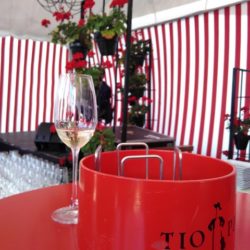
This year’s Bodegas Gonzales Byass tasting event for Tío Pepe en Rama 2016 was held on April 11th (lunes del pescaíto), at the Mercado del Barranco on Seville’s riverside. Although we weren’t too lucky with the weather, with the wind even knocking over a few glasses, master blender (and winemaker poet) Antonio Flores led us on a metaphorical sailing trip down the Guadalquivir river, from Sevilla to Jerez. As we listened to his accounts we sampled the three different sherry wines: Tio Pepe en Rama (fino), Viña AB (amontillado) and Leonor (palo cortado). When you pour the wine, close your eyes, smell the wine and then drink, it shows once again that sherry is not just another white wine, but has a strong connection to the south of Spain, its sunshine, the smell of the sea and the silence inside the bodega. The magic is always there, even when it is raining and the wind is blowing. Catering for the event was supplied by various stalls inside Mercado del Barranco.

Tío Pepe en Rama 2016 was first selected in October from 100 of the best casks from two of the oldest Tío Pepe soleras, Rebollo and Constancia, and finally bottled (16,000 in total) in April from the top 60 out of those initial 100 casks.

A wild unfiltered wine, with all its yeast and organic contribution. Yellow, pale, golden tones, cloudy (yeast in suspension). The nose is pure albariza, salinity, nuts, bakery aromas. Tasty, intense, long, salty and slightly bitter finish. Or as Antonio would say… el sol de Andalucía embotellado (bottled Andalusian sunshine).

You can order Tío Pepe en Rama 2016 from the Gonzalez Byass online store or (in Sevilla) buy it at El Corte Inglés Gourmet Experience Duque.

tio pepe en rama 16 (12)

tio pepe en rama 16 (2)

tp en ramaAntonio Flores with Aldara

tio pepe en rama 16 (3)

tio pepe en rama 16 (4)

tio pepe en rama 16 (5)

tio pepe en rama 16 (7)

tio pepe en rama 16 (6)

tio pepe en rama 16 (8)

tio pepe en rama 16 (1)


Seville | Calvisius Caviar Tasting at Sea Market

caviar (1)
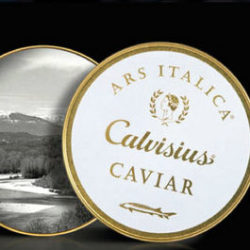
We Love Tapas had the opportunity for a visit to the recently opened Sea Market restaurant in the Avenida Eduardo Dato in Seville. We had been invited to attend a tasting of one of the most highly regarded, but possibly least known products of the sea – caviar. The tasting was hosted by Calvisius Caviar, by Export Manager Sara Morales, who began by giving us a masterful tour through the history of caviar and the different kinds of caviar produced under their brand name, which come from various species of sturgeon, before going on to the tasting itself.

caviar
We tried four different kinds of caviar, each time being given just a few of the small black eggs that we had to put on the back of our hands until they were the perfect temperature. Then, while we rolled them around in our mouths, Sara explained all the flavours, textures and smells we were eperiencing! After each tasting we were served a perfectly chosen cava from Llopart, to pair with the particular caviar we were tasting.

cava

It was a great introduction to the mysteries of caviar, but there was also a negative side to our experience at Sea Market. It is easy to be impressed when you visit the restaurant, as it is a very chic establishment: everything is what you would expect from a modern restaurant, with an aesthetic and atmosphere that many people are looking for.

But though these things are obviously important, it is also important to take care of other aspects of a business that serves the public, and we were disappointed with the standard of service we received. The serving staff appeared to be lacking in training in how to serve these particular delicacies, although this event must have been an important one for a new restaurant. Recognised brands like Calvisius and Llopart, and the various dishes the chef prepared for us during the tasting, definitely deserved better.

Semana Santa in Seville

semana santa

Semana Santa (Holy Week) is Spain’s major annual religious extravaganza, but nowhere is it celebrated on a scale, or with such fervour, as in Seville. From Palm Sunday (although because the processional timetable is so full some brotherhoods go out on the preceding Friday and Saturday) through to Resurrection Sunday the city virtually shuts down as the processions make their way to the Cathedral and back again. Even in this day and age, when religious observance is on the decline, the processions still draw substantial crowds, and for many of those taking part, whether as penitents, musicians or officials, Holy Week is the focal point of the year, and huge investments of time, money, and emotion go into making it the spectacle it is.

semana santa (2)

But what’s it all about? This is actually quite a complex question. The bare bones don’t seem too complicated. The processions are organised by rather more than forty brotherhoods (hermandades or cofradias) attached to the city’s churches and other religious institutions. The order of the processions during the week follows the events of the original, and each procession consists of at least one, usually two (a Christ and a Virgin), and occasionally three pasos (the floats bearing the religious figures), which are carried from their “homes” to the Cathedral to be blessed. The pasos are accompanied by penitents in traditional robes and hoods (every brotherhood has its own colours) to maintain their anonymity, marching bands, and the various officials who control the movement of the procession.

The origins go back to the 16th century, when the earliest, and simpler, processions made their way from Casa Pilatos (Pilate’s house) to the Cruz del Campo, the Cross in the Field (from which local brewer’s Cruzcampo take their name), but from 1604, by order of the Cardinal, they were obliged to pass through the Cathedral. The use of pasos began around the same time, and increased steadily through the 17th century, which was Seville’s Golden Age of artistic patronage. Then as now, the processions were organised by the hermandades, charitable and mutual aid organisations affiliated to particular churches and trades. At a deep level these were ritual expressions of a social solidarity that has not been entirely lost, even in the present day.

semana santa (1)costaleros taking a break

The floats are carried by teams of costaleros, who bear the weight on the backs of their necks, protected by a sack or costal wound around the head. Because the costaleros are hidden from view by curtains the floats appear to move by themselves (the costaleros are guided by a capataz with a code of taps with a hammer), often with a swaying motion that makes them seem almost alive. Some of the tight corners in the narrow streets are difficult to negotiate, and the costaleros practice the routes for weeks beforehand.

The floats and figures, some of which are important works of art in their own right, are richly decorated and often decked with flowers and candles. With the solemn files of penitents carrying crosses and long candles, and the distinctive music of the bands, the processions can be quite affecting, even for the non-religious, and this is especially true of the processions that go out overnight on Thursday to pass through the cathedral in the early hours of Good Friday.

semana santa (5)chairs stacked in front of La Campana

All the processions pass along the “Sacred Way” as they approach the Cathedral. This runs from La Campana, along Calle Sierpes, through the Plaza San Francisco, and up the Avenida de la Constitución. Terracing with seats (at a price) is provided for the spectators in the last two, and is highly prized for the views of the processions. It is sometimes said there are two types of Sevillanos – those who attend all the processions, and those who leave town for the week.

semana santa (3)

Not surprisingly with so many people coming into town for the week, hotel and apartment prices increase significantly, so if you’re on any sort of budget and aren’t coming for the religious festival, it may be best to plan your holiday for a different time. As well as that many bars, especially in the centre, will abandon tapas for the week in favour of raciones or a menu del día to improve efficiency.

With that said, however, spring is still the best time to come to Seville, as the weather is usually pleasantly warm and sunny, and the parks and gardens in full bloom. If you’re lucky you may be here when the orange blossom is out, filling the city with its perfume.  And Semana Santa in Seville is one of those unique events that you should try to experience once in your life.

photos courtesy of azahar-sevilla.com

Seville Cycling & Tapas Tour

tapas cycling

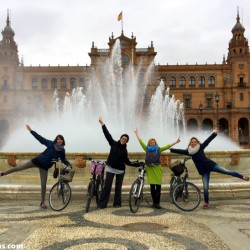
We Love Tapas and ELECMOVE created a very special collaboration a few months ago – the Cycle & Tapas Tour –  offering an introduction to Seville on electric bikes followed by a delicious Traditional Tapas Tour. But it was only recently that the WLT Team got together with ELECMOVE to experience the electric bike tour themselves. And the ELECMOVE team also got to sample tasty tapas with us. Really, a match made in heaven.

cycling tapas (1)

We met up at ELECMOVE at 10.00 am and our cheerful guide Marie immediately set about getting us set up with out bikes, adjusting seat heights, checking tire pressure, snapping on baskets for those who wanted it. And then we got a quick lesson on how electric bikes work. Pretty easy really.

cycling tapas (2)

The route for the Introduction to Seville tour is at least 90% on cycle paths, stopping off at places of interest.

cycling tapas (3)

Marie kept asking if we wanted to stop for photos, so…

cycling tapas (4)

Here we are in front of the Royal Tabacco Factory where Carmen once rolled cigars on her gypsy thighs…

cycling tapas (5)

The WLT chicas replicating the poet Becquer’s three phases of love.

cycling tapas (6)

Marie explains Mudejar architecture in Parque María Luísa

IMG_6903Team WLT Sevilla: Delia, Sara, Ania & Aldara

cycling tapas (7)Team ELECMOVE: guides Marie & Juan, owner Sofia

CYCLING & TAPAS TOUR

Seville | Alternative Markets

Alternative shopping

At this time of year with Christmas just around the corner Seville city centre is crowded with shoppers looking for the best presents they can find. But how can we make our loved ones happy while still supporting local businesses? Actually, there are plenty of options and we’ve come up with this little guide to help you.

Craft Markets

mucho-mas-que-market

  • Mucho Maske Market
    This little craft market started up 9 years ago, and has been held in a variety of locations. This year it’s in the Regina area behind the Metropol Parasol (calle Viriato, 9) from the 17th until the 20th of December and will showcase 19 different brands, including jewellery and wooden toys.

12308556_1014598065268958_718657792021520578_n

  • El Butrón Market
    El Butrón is a cultural space where artists can meet and display their creations in temporary exhibitions. This is it’s 4th year, and it’s running from the 18th to the 20th of December at calle Butrón, 7, with workshops, music and organic food.

mercadoartesania

  • Mercado de Artesanía
    Organized by the Federación Artesanal de Sevilla and the City council Seville’s famous annual hadicraft market is already open in Plaza Nueva and will be there until the 5th of January, with a wide range of quality merchandise to choose from.

Shopping by Barrio

Captura de pantalla 2015-12-18 a las 15.03.57
Regina Market

The Regina market, actually an association of small local shops in Viriato, Jerónimo Hernández and Amparo streets, offers an individualistic style of shopping, with a mix of the moderni and the traditional. Some of the shops you can explore to find your presents are Un gato en bicicleta, La seta coqueta, Wabi Sabi, Un Globo or Pai-pai shop.

Captura de pantalla 2015-12-18 a las 15.34.11

Soho Benita
On the southern side of Las Setas we find another big area full of small fashion, design, and art places, together with some of the bars we visit in our tours and recommend in this blog. Spend a day in this neighbourhood and discover how Seville can be traditional and surprising at the same time. Soho Benita shops are Artefactum, Delimbo, Eirín, Florypondio, Isadora, La Importadora, Le Voilà, Patricia Buffuna, Taranta, Rayuela, Zález, Made with lof, Zapata and Verde Moscú, among others.

Feria/San Luis/Macarena
As well as “el Jueves” in calle Feria, the oldest flea market in Europe that takes place every Thursday morning, there are many handicraft workshops that have appeared in this neighbourhood in recent years.

  • La Osa Mallol
    A couple of years ago two great designers joined forces to share a space where they could create and sell their range of clothing, as well as teaching others how to do the same. Their names are Hisabelia and Loulitas and La Osa Mallol is their studio/atelier (Pasaje Mallol, 31). Whenever you go there they will offer you a cup of tea, but this weekend there will also be anisette and polvorones (Spanish Christmas’ shortbreads).315716_120518291442989_704227686_n
  • Desmontando a La Pili
    Diversity, feminism and responsible consumption are the name of the game here. So that you can be sustainable even in bed, Mónica Ortiz has come up with some options to make sex better. Her products, available through her website and her fantastic Tuppersex meetings, are designed for learning, solving problems and having fun. Give yourself or someone you love some pleasure and contact her at info@desmontandoalapili.com or find her at Tramallol (Pasaje Mallol, 22).12369190_425599504231584_7641245861606291842_n
  • Rompemoldes
    This is a group of workshops specialising in a variety of different crafts. Some are also shops where their products are sold, while others work on commission only basis. Located in a council owned building, this is a secluded space with a wonderful courtyard full of plants. Open the door (San Luis, 70) and sneak in, you won’t regret it!61444_129336633888982_1235443666_n
  • Lino y fino
    Petra started creating and selling handmade linen clothes in Tarifa, near Cadiz, in 1998. She now has two more shops, and we are lucky to have one at calle San Luis, 72. She uses 100% pure linen for unique women’s, men’s and children’s clothes. She also uses some warmer fabrics for winter!10639723_765154423569614_5246665074246108001_n
  • Santa Cleta
    There are many bike shops in Seville, a result of growing interest in green transport options, but the most sustainable, committed and active one is Santa Cleta. They won’t only sell you a bike, but will also teach you how to ride it, no matter what your age, and how to maintain and repair it! Ride, or walk, to Plaza del Pumarejo and take the street on the right hand side of the old palace: Fray Diego de Cádiz, 24.1000779_553683444691065_347742336_n


Remember: Think global, shop local and buy handmade.

Callejeando Food Fest in Sevilla

What does foodie heaven look like? We bet it looks something like this…

sunset

It all happened this past weekend in Seville and of course we were there, eating and drinking non stop! There were 19 different food trucks from all over Spain with their delicious creations. To start we tried out our own local food truck, La Cayejera, which can usually be found under Triana bridge or at Torre Pelli.

callejeando (6)

The food truck concept was developed in USA but though the idea has been imported from the states, everything else is local, like this amazing Retinto beef with Payoyo cheese from Cadiz, the basic ingredients for the Brilla Bombilla hamburger.

callejeando (7)

In Spain we know all about meat, which is why Ox&Roll people were more than prepared to raise a very special one here: Wagyu. You may have heard about Kobe but this is the 100% real one, the genuine article guaranteed by Japanese organizations. They take great care of the animals and of the whole production process, and the result is the tastiest steak we have ever tried.

callejeando (3)

Culinary fusions are another important element in food trucks recipies, and Tabe Gozo is a perfect example. They were travelling around when came up with the idea of a basque-japanese mix for their project. They even make their own bread.

callejeando (2)

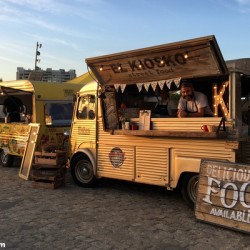
El Kiosko came with one of their three food trucks and created a special crispy chicken and nachos burger just for this event! BoKarte is its name and here you can learn how to make it: Bokarte de Pollo

callejeando (8)

These guys spent 15 hours driving to get here from Barcelona, but it was worth the ride because they surprised everybody with their chips nest, as you can see by the long line of hungry customers. La Internacional is an example of how passionate one must be to start this adventure and how successful it can be.

callejeando (4)

On a recent national TV show called Cocineros al Volante food trucks had to prove their value, and we have the winner here: Javier Brichetto. As you can imagine, we were already really full by then but he had created a burger good enough to be considered the best among so many others…so we had to try it!

callejeando (5)

Since nature gave us a separated stomach for dessert we could still enjoy Manu Jara’s surprising creations. He prepares cookies, truffles, cakes, and of course his signature choco-burger.

The event has been such a success that they are planning to do it every three months so we will keep an eye out for this Festival, in the hope that there will be more food trucks coming!

Jerez | Ruta de Tabancos

tabancos (1)

Jerez de la Frontera is a short train ride away from Seville and is, of course, most famous for its local wine – sherry. While you are there you should not only visit one of the city’s many bodegas, but also do at least part of the “Ruta de Tabancos“. Tabancos are a type of bar or tavern that is typical of Jerez de la Frontera, combining the social function of a bar and the commercial function of a “despacho de vinos”, or wine shop, selling wine from the cask to take away or for consumption on the premises. The earliest known use of the word is in Cervantes (1547-1616), of Don Quixote fame, and may be a combination of the words “estanco” (a shop selling government controlled products) and “tabaco”. We don’t really know what these early tabancos may have been like, but the word doesn’t seem to have caught on until the early 20th century, when it began to be used in its modern sense.

tabancos (4)Ruta de Tabancos map by Tabancora

After a period of decline in the late 20th century tabancos have had a resurgence, and now include some more modern influences to complement the traditional. The Ruta was developed by Tabancora (promoted by the City Council and the Sherry Academy) to help maintain the traditions of the tabanco, and several times a year there are special Ruta events. Recently –  in the spirit of Serious Research – the We Love Tapas Team undertook the gruelling 😉 task of visiting each bar on the Ruta. These are our findings…

tabancos

Tabanco El Pasaje
Santa Maria, 8
Tel: +34 956 333 359
Website

El Pasaje was officially founded in 1925 by Don José González Navarro, which makes it the oldest tabanco still operating in Jerez, but even before this the premises had functioned as a small grocer’s, and later as a flamenco club for the waiters of Jerez. Flamenco is still an important part of the ambiance, with live flamenco shows on Friday and Saturday evenings, and sometimes impromptu performances at other times. The name derives from the fact that it has two entrances, so the bar itself is a “passage”. Sherries are by Bodega Sierra Maestro, and some others are available too. A very traditional and fun atmosphere, and light tapas snacks are also available.

tabancos (5)

Tabanco San Pablo
San Pablo, 12
Tel: +34 956 338 436
Website

Another very traditional tabanco founded in 1934 by Manuel Muñoz Peña, and still run by his descendants. It still has the original wooden counter and sherry casks (sherries by Gonzalez Byass), and you can try some typical Andaluz tapas, such as jamón and pringá, with your drink. There is also a pleasant terrace outside, though it’s all self-service here.

tabancos (9)

Tabanco La Pandilla
Los Valientes, 14
Tel +34 956 343 248
Website

La Pandilla first opened its doors in 1936. Closed in 1979 during the decline of tabancos, it reopened again in 2013, and still preserves a lot of the original decor and ambiance, including the beautiful wood beam ceiling and old posters and pictures on the walls. The original Sanchez Romate sherries are still served, along with filled rolls, cured meats, cheeses and marinades.

tabanco

Tabanco Plateros
Francos, 1
Tel: +34 665 213 415
Website

Plateros has a terrific location on the corner of the square of the same name with a pleasant terrace outside, though the bar itself is tiny. It specialises in sherries from some of the smaller bodegas and cooperatives, and local cured meats and cheeses. Super friendly staff and great “local” atmosphere.

tabancos (3)

Tabanco El Guitarrón de San Pedro
Bizcocheros, 16
Tel +34 649 656 918
Website

Opened in 2012 by Jose Antonio Reguera and Mireia Rodríguez, this is a relatively modern and “upmarket” tabanco, but has all the essentials of the genre. There’s a full range of sherries, as well as cured meats, cheeses and preserves (and one of the best tortilla de patatas I’ve ever had). They also do tastings, and events to educate people about sherry, and there are regular flamenco performances.

tabancos (7)

Tabanco Las Bandarillas
Caballeros, 12
Tel: +34 619 006 988
Website

Also opened in 2012, by Fernando Lobato and Lucas Soto, Las Bandarillas replaced an existing bar-restaurant of the same name. As well as sherry and vermouth from the barrel there are preserves and delicatessen products to eat on the premises or take away, and a good selection of hot tapas. In fact, it has more of a tapas bar than tabanco feel to it, but still a fun and lively place to stop.

tabancos (12)

Tabanco La Bodeguita
Arcos, 5
Tel: +34 607 892 221

Opened in 1947 by Rafael Ramirez Pérez, and now run by Fernando Lobato, La Bodeguita has been described as more Jerezano than Jerez itself. A small counter at the back serves for the consumption of an ample selection of  sherries drawn straight from the barrel. An even bigger selection is available in bottles ranged along the shelves to one side. Nothing can really prepare you for La Bodeguita, just go and see for yourself. We loved the welcoming and convivial atmosphere.

tabancos (10)

Mushroom Season

amaritasamanitas cesáreas

Autumn is here, even in Spain, and among the things this season brings with it are wild mushrooms. Country people have always gathered mushrooms for the pot at this time of year, but in Spain in recent decades harvesting mushrooms has become a popular weekend pastime, taking advantage of the temperate weather to get out and about in the woods and fields. It goes without saying, of course, that you should only do this if you are, or are with, an expert in the identification of mushrooms, as although there are only about 50 toxic species out of more than 2,000, half a dozen of these are deadly, and some are easily mistaken for those tasty specimens you’re looking for.

modestoseasonal mushroom selection at Restaurante Modesto

Although in the English language the term mushrooms is reserved for edible varieties, the rest being usually described as toadstools, they are all fungi, neither animal nor plant, but an entire separate kingdom of organisms, of which the visible mushroom or toadstool is only the fruiting body of a network of filaments that draw their sustenance from living or decaying matter. Remarkably, some of the largest living creatures on earth are actually fungi.

wild mushroomswild mushrooms at Mercado de la Encarnación

Many mushrooms are grown commercially, and are available all year round, but in the autumn a wide variety of wild mushrooms, broadly known as setas in Spanish, though this word is also used for certain specific varieties, too (the common, mainly commercially produced button mushrooms are champiñones), make their appearance in bars, restaurants and markets. Each of them has its own distinct taste and texture, and its own preferred uses.

amaritas azoteagrilled amanitas cesáreas with pesto and parmesan at La Azotea

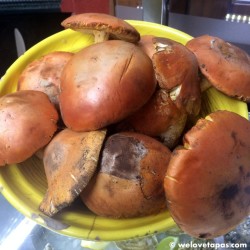
Boletus (also known as porcini) is one of the most prized. It has a large brown cap that can grow up to 35cm in diameter, though smaller ones are preferred. It has a meaty taste and creamy texture. Most used in soups, pastas and risotto, and is also great in croquettes.

Amanitas cesáreas (Caesar’s mushroom) was a favourite of the Roman emperors. It has a distinctive orange cap and yellow gills and a delicate texture.

Setas, or oyster mushrooms, come in a variety of species, all wide, flat gilled mushrooms, often without a stem. They are normally torn or broken up rather than sliced, and are particularly good for stir fry or sauté.

Níscalo, also known as saffron milk-cap or red pine because of its colour, is often fried whole with garlic and parsley.

Gurumelo is one of the most prized of all wild mushrooms, and is unique to southwestern Spain. Claimed to improve almost any dish, it can be braised, or added to stews or omelettes.

Sevilla | NO8DO

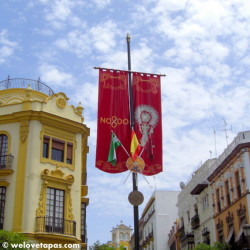
As an observant visitor to our fair city of Seville, you may have noticed, on such diverse objects as lampposts, manhole covers, buildings and garbage trucks, among others, a little motif that seems to read NO8DO, except that the 8 is somewhat large, and often appears as if a little blurred. You may guess from its locations that it is some sort of official logo (it’s actually the city motto), and you may even have wondered what it means. Allow me to explain.

no8do 2

The motif is what is technically known as a rebus (a riddle or puzzle made up of letters, pictures and/or symbols whose names sound like the parts or syllables of a word or phrase). The central 8 represents a skein of wool, in Spanish “madeja”, and yields a phrase that sounds like no-madeja-do, and approximates the Spanish phrase “no me ha dejado” (the h is silent so it’s pretty close), which means “It (Sevilla) has not abandoned me”.

no8do flag

So why is this phrase the motto of the city? Thought you’d never ask. It all goes back to the 13th century (as so much does in these parts), and to the reign of Alfonso X, who succeeded to the throne of Castile and Leon (the castle and lion that you see on the heraldic shield of the Spanish kings) on the death of Ferdinand III, who reconquered Seville from the Moors, in 1252. Known as the Wise, this was more for his intellectual accomplishments than his statecraft, and he was often at odds with his nobles. He had two sons, Ferdinand (the elder) and Sancho. The times were troubled and turbulent, and in the course of one of the intermittent wars with the Moorish kingdom of Granada, Ferdinand was killed at the Battle of Ecija (1275).

no8do

Now Ferdinand had two young sons, and in the normal course of things the line of succession would have passed through them, but taking advantage of the fact that they were still children, Sancho invoked a principle known as Agnatic Seniority (basically this meant that the succession should pass to the younger son of the King (ie Sancho), and not to the children of the deceased older son. Alfonso backed the claim of Ferdinand’s children, the nobles backed Sancho, and civil war ensued. Most of the country was soon under Sancho’s control, but Seville remained loyal to Alfonso (they did not abandon him), and were granted the motto as a reward. Alfonso died in 1284 with the succession issue not officially resolved, although it was Sancho who in fact gained the throne.

So now that you know the story you will no doubt see NO8DO everywhere you go. And now you will know why.

Wheels Up!

Update January 2017: The Seville wheel is no longer operational.

Ferris wheels have been around as a fairground attraction for a long time now (the first was designed and erected by George Washington Gale Ferris for the 1893 World’s Fair in Chicago), but over the last couple of decades they have become increasingly popular as a sightseeing aid for tourists, especially since the opening of the London Eye in 2000, and the trend has now reached southern Spain, with observation wheels (called norias in Spanish) having been recently erected in both Seville and Malaga.

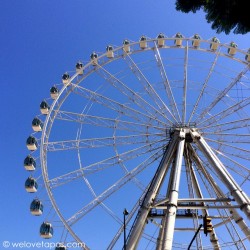
wheels (1)Seville Wheel

At 50 metres (Seville) and 70 metres (Malaga) high these are not particularly big compared to the giants of the genre (the London Eye is 135 metres, and the world’s largest, the Las Vegas High Roller, is a vertigo inducing 167 metres), but they’re still tall enough to get you up above the surrounding buildings and give you a good view of their surroundings.

wheels (2)view from the Seville Wheel

Seville’s wheel can be found at the end of the Muelle de Las Delicias, near the new aquarium, a part of town that is being improved to attract visitors, and its best views are along the river towards the city centre. There are 3o capsules (including a VIP capsule), and rides last about 15 minutes (4 circuits), at a cost of 7.50 euros, or 5.50 for children under 4 years old. Open daily from 10 am to 11 pm (midnight Fridays and Saturdays).

malaga wheelMalaga Wheel

The Malaga wheel is on Avenida de Manuel Agustín Heredia, near the bus station by the port, and is an extension of the Muelle Uno harbour development. There are 42 capsules (but no VIP one), and there are great views across the harbour and old city to the Alcazaba and beyond. Rides last 15 minutes (3 circuits) and cost 10 euros for adults and 6 for children. Open daily 11 am to 11 pm (1 am weekends).

wheels (3)view of the Malaga Wheel from Muelle Uno

Seville Museums

For some people “cultural” stuff like art or historic monuments is what you do between eating and drinking and more eating and drinking. For others, it’s the other way around. But whichever kind of holidaymaker you are, you are likely at some point to find yourself in a museum. Seville has lots of these, covering a wide range of subjects, so this is our handy guide to finding a museum that suits you.

We won’t be delving here into the art collections of places like the Cathedral, the India Archives or Casa Pilatos; we’ll be looking at Museums devoted to fairly specific themes.

museo popular artsMuseum of Popular Arts & Traditions

Seville has two top class art museums. For lovers of classic paintings and sculpture there’s the Bellas Artes (Fine Arts) Museum, featuring mainly Spanish artists from mediaeval times to the early 20th century, such as Murillo, Valdés Leal and Goya, all housed in a splendid 16th century former convent. For fans of modern art the Andalucian Centre of Contemporary Art can be found in the old Cartuja monastery on the Expo ‘92 site across the river. Look for the chimneys of the old pottery kilns.

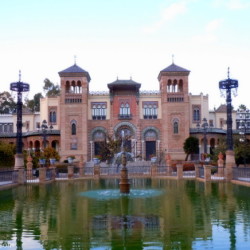
Another group of museums focuses on people’s daily lives, entertainment and culture. The Museum of Popular Arts and Traditions in the Mudejar Pavilion, built in Maria Luisa Park for the 1929 expo, has a recreation of a Sevillano house, and collections of furniture, utensils, clothing, religious objects, ceramics and the like. You can see more ceramics in the setting of one of Triana’s old pottery workshops, including the kilns and the history of pottery and tile making techniques.

flamenco museumMuseo del Baile Flamenco

Two popular entertainments central to Andalucian culture are bullfighting and flamenco, and both have their own dedicated museums. The bullfighting museum can be found at the Real Maestranza bullring, and the guided visit includes not only the museum, but also the arena (arena is Spanish for sand), chapel, pens and other parts of the installations. The Flamenco Dance Museum is the only one of its kind in the world and has an interesting collection of memorabilia and information about flamenco. In the evenings they also have the best Flamenco show in town. Even if you think you’re not interested in flamenco go and see it.

In a city as ancient as Seville it’s only right that there should be a number of museums on the subject of history. Most important is the Archaeological Museum, in the Renaissance Pavilion facing the Popular Arts Museum. It’s most important exhibit is the Carambolo Treasure, comprised of 24 gold items discovered in Camas, near Seville, in 1958, and thought to belong to the Tartessos culture of the 1st millenium BC. The largest collection is of Roman objects, many from Italica, the Roman city in Santiponce, and from other archaeological excavations around Seville. More Roman remains can be found at the Antiquarium, under the iconic Metropol Parasol. There are also smaller museums of the Jewish period and the Moorish legacy, as well as the Inquisition Museum in the Castillo San Jorge.

Some other museums that are worth a visit include the Military Museum (Plaza España), the Naval Museum (Torre del Oro) and the Navigation Pavilion (on the ’92 expo site).

5 Top Museums

Bellas Artes Museum
Plaza del Museo, 9
Tel: +34 955 542 931
Website

Archaeology Museum
Plaza de América, s/n
Tel: +34 955 120 632
Website

Museum of Art and Popular Traditions
Plaza de América s/n
Tel: +34 955 542 951
Website

Andalucian Centre for Contemporary Art
Monasterio de La Cartuja, Avenida Américo Vespucci, 2
Tel: +34 955 037 072
Website

Flamenco Dance Museum
Manuel Rojas Marcos, 3
Tel: +34 954 340 311
Website

Sherry 101

Although there may be other “sherry style” wines, true sherries are those wines, and only those wines, produced in the area around Jerez de la Frontera in southwest Spain, or more specifically, those wines aged in the towns of Jerez, Puerto de Santa Maria, and Sanlúcar de Barrameda under the rules of the Consejo Regulador for the “Denominaciones de Origen” of Jerez and Manzanilla.

sherry and tapas (1)

We meet a lot of people who associate sherry with that sweet, dark liquid produced for Christmas gatherings by grandmothers and maiden aunts, but there’s a whole world of sherries beyond this, and its aficionados consider it as possibly the world’s most fascinating and underrated wine. So what’s so special about sherry?

Sherries come in a range of styles from light super-dry wines to dense, dark sweet ones. Historically, England has a long connection with sherry (they were highly praised by Shakespeare); English names like Harvey’s and Humbert & Williams feature among the bodegas of Jerez, and the English have been a major consumer of cream sherries in particular. But although there are some excellent wines right across the spectrum, the upsurge of interest in recent years has been in the dry sherries in particular.

saturday sherry

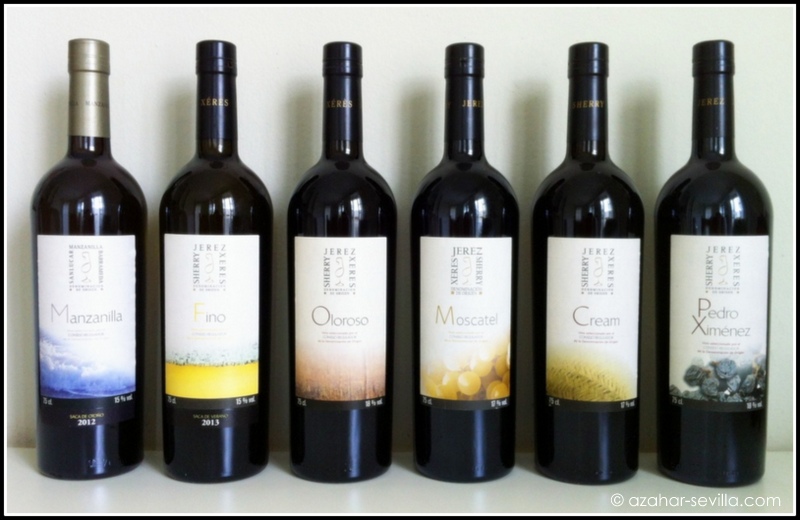
Dry sherries come in two basic styles – those that are biologically aged under a layer of yeast (called flor), and those that are aged oxidatively, or in contact with the air. The former are either Manzanillas (from Sanlucar), or Finos (from Jerez and El Puerto), and the latter are Olorosos (there are some additional twists to the story, but more of that later). All dry sherries are made from the Palomino Fino grape variety (Manzanillas and Finos generally from the first pressing to make a lighter wine, Olorosos from the second for a fuller body; the third pressing is used for grape spirit and vinegar), are fortified (have grape spirit added to increase the level of alcohol), and are aged in a system called a solera.

copa jerez

The wine coming out of fermentation is generally around 12%. It is then raised to an alcohol level of around 15-16%, which helps a vigorous growth of yeast to cover and shield the wine from the air while the yeast consumes the sugars in it (biological aging). Olorosos are fortified to even higher levels, about 17-18%, to prevent the yeast from growing (oxidative aging).

Two of the most highly prized dry sherries are amontillado and palo cortado. Amontillados are initially aged like finos, but after about 3 years extra alcohol is added to kill the yeast, and the sherry is thereafter aged oxidatively, creating a complex and versatile wine. Palo Cortados also start life as finos, but the yeast dies or is killed very early on to create what is, in effect, an oloroso made from the lighter first pressing.

sherry tour (4)

At the other end of the spectrum are the sweet sherries. These are made from the sweeter Pedro Ximenez and Muscat grapes. Good sweet sherries are dark, smooth and rich, often with a flavour of raisins, as the grapes are partially sun-dried before pressing to concentrate the sugar.

Cream sherries are a blend of dry sherry (usually oloroso, but fino based cream sherries are also possible) with sweet wines, either moscatel or PX, and are the style that used to be the most popular in Britain, with something of a boom in the 60s and 70s, when brand names like Harvey’s Bristol Cream and Croft Original were in vogue.

sherry tour

If you’re coming to Spain and have never had sherry this is the time to learn something about this complex and enigmatic wine, and to discover why so many of those involved with sherry get so passionate about it. To have a personalised sherry experience we recommend the Introduction to Sherry tour (with tapas!) offered by Official Sherry Educator Shawn Hennessey of Azahar Sevilla, and featured in Telegraph Travel as one of the Top 10 Food and Drink Holidays in Spain.

 photos courtesy of Azahar Sevilla

Sevilla | Abacerías

Updated: July 1, 2016

You may notice, or may have already noticed, as you make your way from bar to bar in search of tapas and a drink, that the word abacería (often antigua abacería) appears in some of the names in a way that suggests a particular meaning. But what meaning?

abaceria

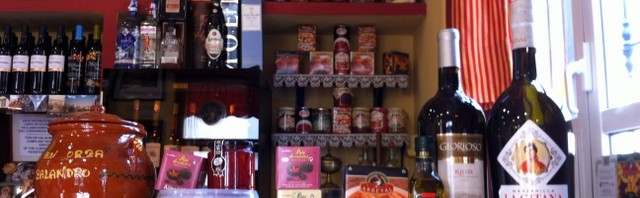
On closer inspection you may notice that as well as being bars, these abacerias are also small shops, selling a variety of foodstuffs, but especially delicatessen (hams and cheeses etc), beans, herbs and spices, and speciality items in tins and jars. In fact, these abacerías (and not all abacerías have the word in the name), were shops first, and shops with a bar later, although the presence of a bar is what distinguishes them from the other type of small grocer’s, the tienda de ultramarinos (literally shop of beyond the sea, originally specialising in products from the New World). The word abacería is Arabic, meaning something like “place of supplies”, and nowadays offer the opportunity to sample anything you’ve bought in the shop while still on the premises. By the mid 20th century abacerias had almost disappeared, but over the last few decades there has been a revival, and both “traditional” and “modern” versions are now very popular.

I love these little treasure troves of culinary delights, where you never know quite what you may find. There’s some nostalgia too; a lot of them have a look and atmosphere of little shops that I remember from my childhood, but transported to a different country and almost magically reinvented. These are some of my favourites, and well worth seeking out for that very special Sevilla experience.

casa moreno

Casa Moreno is one of my favourite places in Sevilla. A tiny shop in front with a little bar hidden away at the back serving mostly montaditos (toasted buns) with delicious meat and cheese fillings. Great atmosphere that’s old fashioned in just the right way.
Casa Moreno
Gamazo
7 Arenal

abaceria san lorenzo

La Antigua Abaceria de San Lorenzo isn’t actually that antigua, though it certainly looks the part. Hidden away in a residential neighbourhood it’s obviously a locals bar, cosy and intimate with everybody on first name terms.
La Antigua Abacería de San Lorenzo
Teodosio 53
San Lorenzo

antigua abaceria triana

La Antigua Abaceria in Triana has something of the feel of a country pub, and is a great little place to stop for a beer and snacks. It’s recently been extended into a second premises next door, but still has the same friendly atmosphere.
La Antigua Abacería
Pureza 12
Triana

la almadraba

La Almadraba is part of a modernising trend at Seville’s oldest market in Calle Feria. As the name suggests it’s all about the tuna, with quality products from top brands such as Herpac.  Don’t miss the mojama (cured tuna). Delicious.
La Almadraba
Feria Market

salsamento
Salsamento is a brand new abacería in the revitalised Regina neighbourhood behind the Metropol Parasol that has succeeded in combining the traditional spirit of the abacería with a totally modern light and clean interior design. There’s a nice mix of cheeses and charcuterie with simple tapas and a nicely displayed range of speciality tinned goods.
Salsamento
Jerónimo Hernández 19
Centro / Regina

federico flores

Flores Jamon y Vinos in Puerta Triana, is a modern, upmarket version of abaceria. Specialising in top quality jamon, but with plenty of other goodies to excite. Eat here or take away, with ham and other cured meats cut to order or available vacuum packed.
Flores Jamones & Vinos
San Pablo 24
Centro/Arenal

Photos courtesy of Azahar Sevilla