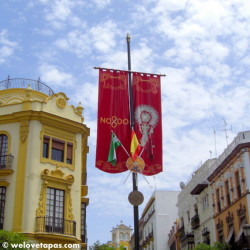
As an observant visitor to our fair city of Seville, you may have noticed, on such diverse objects as lampposts, manhole covers, buildings and garbage trucks, among others, a little motif that seems to read NO8DO, except that the 8 is somewhat large, and often appears as if a little blurred. You may guess from its locations that it is some sort of official logo (it’s actually the city motto), and you may even have wondered what it means. Allow me to explain.

The motif is what is technically known as a rebus (a riddle or puzzle made up of letters, pictures and/or symbols whose names sound like the parts or syllables of a word or phrase). The central 8 represents a skein of wool, in Spanish “madeja”, and yields a phrase that sounds like no-madeja-do, and approximates the Spanish phrase “no me ha dejado” (the h is silent so it’s pretty close), which means “It (Sevilla) has not abandoned me”.

So why is this phrase the motto of the city? Thought you’d never ask. It all goes back to the 13th century (as so much does in these parts), and to the reign of Alfonso X, who succeeded to the throne of Castile and Leon (the castle and lion that you see on the heraldic shield of the Spanish kings) on the death of Ferdinand III, who reconquered Seville from the Moors, in 1252. Known as the Wise, this was more for his intellectual accomplishments than his statecraft, and he was often at odds with his nobles. He had two sons, Ferdinand (the elder) and Sancho. The times were troubled and turbulent, and in the course of one of the intermittent wars with the Moorish kingdom of Granada, Ferdinand was killed at the Battle of Ecija (1275).

Now Ferdinand had two young sons, and in the normal course of things the line of succession would have passed through them, but taking advantage of the fact that they were still children, Sancho invoked a principle known as Agnatic Seniority (basically this meant that the succession should pass to the younger son of the King (ie Sancho), and not to the children of the deceased older son. Alfonso backed the claim of Ferdinand’s children, the nobles backed Sancho, and civil war ensued. Most of the country was soon under Sancho’s control, but Seville remained loyal to Alfonso (they did not abandon him), and were granted the motto as a reward. Alfonso died in 1284 with the succession issue not officially resolved, although it was Sancho who in fact gained the throne.
So now that you know the story you will no doubt see NO8DO everywhere you go. And now you will know why.

 view of Antequera from the Alcazaba
 The Alcazaba was built by the Moors in the 13th century after the Christian kings conquered Cordoba, and finally fell to the future Ferdinand I of Aragon in 1410. It’s well worth a visit, with an excellent audio guide to the castle, and panoramic views of the town and surrounding countryside (look out for the golden angel on top of the San Sebastian church tower). Antequera is also famous for its large number of churches, convents and palaces (it’s sometimes called the city of churches), mostly built in the period of prosperity after the discovery of the New World, and an important museum which you can find in the Nájera Palace in the Coso Viejo.
 breakfast mollete with olive oil, tomato and jamón serrano
 two rings of churros please!
 three types of porra: tomato, blanca and orange