Postcard from Andalucia | Ronda

Ronda is one of our favourite small towns (population 35,000) in Andalucia, and is already a popular tourist destination. It’s situated in the mountains west of Malaga , between the Sierra de Grazalema and the Sierra de la Nieves, and is considered to be one of the “White Villages” of Andalucia. It can be reached quite easily by car or bus from Seville (about 2 hours) or Malaga.

The origins of modern Ronda go back to Roman times, but it’s during the Moorish era that it had it’s greatest fame and importance, even achieving independence for a time in the 11th century, and being one of the last Moorish strongholds to fall to the Christians (1485). It’s also regarded as the birthplace of modern bullfighting, pioneered by the Romero dynasty of bullfighters in the 18th century, and also (by a whisker) of Spain’s oldest bullring, completed in 1784. Both Ernest Hemingway and Orson Welles were great fans, but nowadays there are only a few days of bullfighting a year, during feria in the first week of September. The rest of the year it’s a major tourist attraction, and is well worth seeing.

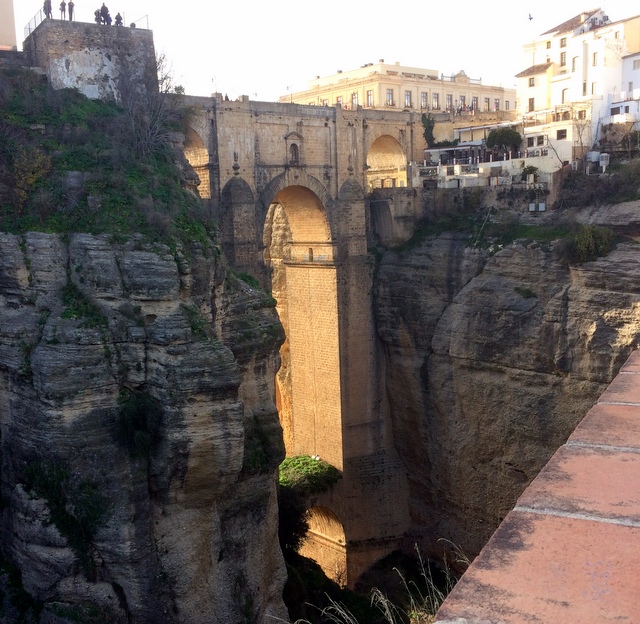
Ronda’s main claim to fame, though, is its stunning hilltop location overlooking the area around – or more precisely two hilltop locations, separated by the Tajo Gorge, a spectacular narrow canyon up to 120 metres deep, with the River Guadalevín running through it. It’s spanned at its highest point by Ronda’s iconic Puente Nuevo (the New Bridge, actually built in the 18th century, but still called new to distinguish it from the older bridges lower down the hill). From here you can look out onto the valley to the west, or down the gorge, with its whitewashed houses perched on the edge, to the Puente Viejo (the Old Bridge, or Arab Bridge, actually built in the Christian era, though there was possibly a previous bridge on the same site) and the Puente Romano (the current structure is relatively modern, but again there are traces of earlier structures at the same place, certainly one from the Moorish period, and possibly from as early as Roman times). Walk down through the Cuenca gardens, visit the Baños Arabes (arab baths), and if you’re feeling fit go down the water mine, a stairway cut through the rock from the upper city down to the river.

At the north end of the bridge is the Christian period new town. As well as the bull ring there is the Alameda de Tajo, a small park at the top of the cliffs with spectacular views, and the churches of La Merced and El Socorro (time permitting).

To the south is La Ciudad, the old city, which has as many interesting things packed into its small area as pretty much anywhere in Spain. Must sees include the old main gate of the city, the Almocabar, with the fortified Church of the Holy Spirit, the old minaret and the central square the Plaza Duquesa de Parcent, where you can find the town hall and the Church of Santa Maria de la Mayor (sometimes referrred to as the cathedral, though it’s not the seat of a bishop). It’s also possible to walk down into the gorge for that classic shot of the New Bridge, and for a closer look at the remains of the old walls and mills. There are also several interesting museums, including the municipal museum in the Casa Mondragon, the House of Don Bosco, a small museum of wine and the Bandits Museum. My favourite, though, is the quirky and eclectic Lara Museum, which you should go and see.

Finally, where should you go to eat? There are plenty of good places, and any list based on the personal opinion of a visitor (even one who’s been a number of times) is necessarily incomplete, but this is my postcard, and this is my short list of places I like. For breakfast, Casa Luciano in the main street of the old town, where I was fortuitously led by a couple of locals on my last visit – great toast and coffee. Another new find was wood grilled meat restaurant El Sacristan, next to the Santa Maria church. Old favourites include La Niña Adela, which is at the top of the new town and a bit difficult to find, but worth the effort, the Almocabar (just outside the gate), and Tragatá, near the New Bridge and bullring.

Finally, a mention for Reservatauro, a bull and horse breeding farm just outside Ronda, where I spent a few fascinating hours learning about fighting bulls and Andalucian horses.

It’s all about the Pig

IMG_9081

As anyone who has been to Spain will already know, when it comes to food the pig holds a special place of affection in the hearts of the Spanish (if you can excuse a rather mixed metaphor). No one knows exactly how long this love affair has been going on, but it’s thought that domesticated pigs were first brought to the peninsula by the Phoenicians nearly three thousand years ago, though the native Iberians had no doubt been hunting the native wild boar for many centuries before that. Although always popular, the centrality of the pig in Spain was cemented in the late Middle Ages as the Christians wrested control from the Moors and the Jews, and the consumption of pork became something of a symbol of the new Christian Spain.

IMG_8821

At some point the boar and the domesticated pigs were crossbred, resulting in the Iberian peninsula’s very own special breed, the famous Iberian black-footed pig. They are raised mainly in the hill country of northwest Andalucia and Extramadura, on a specially maintained landscape called a dehesa, essentially grassland with groves of oak trees, and the pigs fatten by foraging on acorns (Spanish bellota). Although not numerically the majority of Spanish pigs, this is the breed which supplies the unique and highly prized Iberian pork and ham products.

IMG_9206

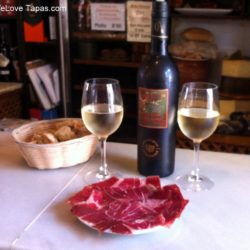
Most prized of all, of course, is the wonderful jamon Iberico Bellota. The combination of breed, free-range diet and the curing process make this the treat not to be missed. Succulent and full of flavour, it is arguably the best ham in the world, and for the full Spanish effect it should be accompanied by a glass of chilled manzanilla or fino. You should also try caña de lomo, a cured Iberian pork loin with a subtly different taste and texture.

IMG_8855

But it’s not all jamon. Traditionally, every part of the pig is used. Lean cuts such as presa or solomillo are normally grilled (solomillo is popular with a whisky sauce with lots of garlic and a hint of lemon that’s absolutely delicious). The slightly fattier pluma and secreto, as well as bacon, may be either grilled or fried. But it doesn’t stop there. Tender stewed pork cheeks (carrillada) seem to be one of Spain’s best kept culinary secrets. So too is morcilla, or blood sausage. The idea can be off-putting to some, but in fact it’s very tasty, and very versatile.

But when I say every part of the pig is used, I mean every part. From tripes (the secret’s in the sauce) to feet and from snout to tail, it’s all part of somebody’s favourite dish. I’ve tried pretty well all of them at one time or another, and haven’t found one that I don’t like. How many are you going to try while you’re here?

IMG_8778

Sevilla | NO8DO

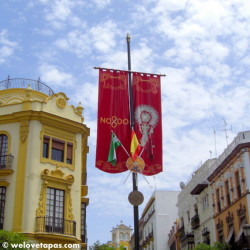
As an observant visitor to our fair city of Seville, you may have noticed, on such diverse objects as lampposts, manhole covers, buildings and garbage trucks, among others, a little motif that seems to read NO8DO, except that the 8 is somewhat large, and often appears as if a little blurred. You may guess from its locations that it is some sort of official logo (it’s actually the city motto), and you may even have wondered what it means. Allow me to explain.

no8do 2

The motif is what is technically known as a rebus (a riddle or puzzle made up of letters, pictures and/or symbols whose names sound like the parts or syllables of a word or phrase). The central 8 represents a skein of wool, in Spanish “madeja”, and yields a phrase that sounds like no-madeja-do, and approximates the Spanish phrase “no me ha dejado” (the h is silent so it’s pretty close), which means “It (Sevilla) has not abandoned me”.

no8do flag

So why is this phrase the motto of the city? Thought you’d never ask. It all goes back to the 13th century (as so much does in these parts), and to the reign of Alfonso X, who succeeded to the throne of Castile and Leon (the castle and lion that you see on the heraldic shield of the Spanish kings) on the death of Ferdinand III, who reconquered Seville from the Moors, in 1252. Known as the Wise, this was more for his intellectual accomplishments than his statecraft, and he was often at odds with his nobles. He had two sons, Ferdinand (the elder) and Sancho. The times were troubled and turbulent, and in the course of one of the intermittent wars with the Moorish kingdom of Granada, Ferdinand was killed at the Battle of Ecija (1275).

no8do

Now Ferdinand had two young sons, and in the normal course of things the line of succession would have passed through them, but taking advantage of the fact that they were still children, Sancho invoked a principle known as Agnatic Seniority (basically this meant that the succession should pass to the younger son of the King (ie Sancho), and not to the children of the deceased older son. Alfonso backed the claim of Ferdinand’s children, the nobles backed Sancho, and civil war ensued. Most of the country was soon under Sancho’s control, but Seville remained loyal to Alfonso (they did not abandon him), and were granted the motto as a reward. Alfonso died in 1284 with the succession issue not officially resolved, although it was Sancho who in fact gained the throne.

So now that you know the story you will no doubt see NO8DO everywhere you go. And now you will know why.