It’s all about the Pig

IMG_9081

As anyone who has been to Spain will already know, when it comes to food the pig holds a special place of affection in the hearts of the Spanish (if you can excuse a rather mixed metaphor). No one knows exactly how long this love affair has been going on, but it’s thought that domesticated pigs were first brought to the peninsula by the Phoenicians nearly three thousand years ago, though the native Iberians had no doubt been hunting the native wild boar for many centuries before that. Although always popular, the centrality of the pig in Spain was cemented in the late Middle Ages as the Christians wrested control from the Moors and the Jews, and the consumption of pork became something of a symbol of the new Christian Spain.

IMG_8821

At some point the boar and the domesticated pigs were crossbred, resulting in the Iberian peninsula’s very own special breed, the famous Iberian black-footed pig. They are raised mainly in the hill country of northwest Andalucia and Extramadura, on a specially maintained landscape called a dehesa, essentially grassland with groves of oak trees, and the pigs fatten by foraging on acorns (Spanish bellota). Although not numerically the majority of Spanish pigs, this is the breed which supplies the unique and highly prized Iberian pork and ham products.

IMG_9206

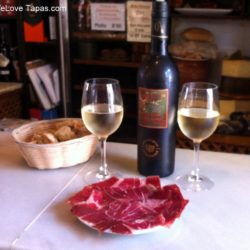
Most prized of all, of course, is the wonderful jamon Iberico Bellota. The combination of breed, free-range diet and the curing process make this the treat not to be missed. Succulent and full of flavour, it is arguably the best ham in the world, and for the full Spanish effect it should be accompanied by a glass of chilled manzanilla or fino. You should also try caña de lomo, a cured Iberian pork loin with a subtly different taste and texture.

IMG_8855

But it’s not all jamon. Traditionally, every part of the pig is used. Lean cuts such as presa or solomillo are normally grilled (solomillo is popular with a whisky sauce with lots of garlic and a hint of lemon that’s absolutely delicious). The slightly fattier pluma and secreto, as well as bacon, may be either grilled or fried. But it doesn’t stop there. Tender stewed pork cheeks (carrillada) seem to be one of Spain’s best kept culinary secrets. So too is morcilla, or blood sausage. The idea can be off-putting to some, but in fact it’s very tasty, and very versatile.

But when I say every part of the pig is used, I mean every part. From tripes (the secret’s in the sauce) to feet and from snout to tail, it’s all part of somebody’s favourite dish. I’ve tried pretty well all of them at one time or another, and haven’t found one that I don’t like. How many are you going to try while you’re here?

IMG_8778

Nights in the Gardens of the Royal Palace

noches jardines

Update: This year’s Noches en Los Jardines de Los Reales Alcazares run from June 14th to September 8th, 2017

Despite the heat there are lots of good reasons to come to Seville in the summer time, and plenty of things to see and do when you’ve finished lounging by the pool or sitting in pavement cafes with a cold drink watching the world go by. And it’s a particularly good time to be here if music in the open air and beautiful gardens are your thing, because from the 14th of July to the 30th of September the Alcázar Palace will be hosting the 19th edition of its annual summer season of concerts, Nights in the Gardens of the Royal Palace.

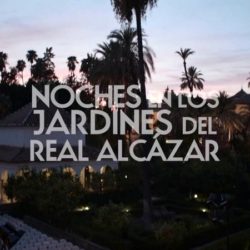
The setting could not be more perfect. The gardens of the Royal Palace are among the most beautiful in Spain, full of colour, fountains and shady grottoes and pavilions where the elite of Spanish society once amused themselves. The concerts themselves take place against the backdrop of the Wall or Gallery of Grotesques, a part of the old city wall whose upper part was converted into a covered walkway for viewing the gardens, and decorated with stones, shells and carvings. As night falls the air cools and the lights come on to magical effect.

The concerts feature top class performers, and a range of styles, classified under five headings to help you find what you’re looking for – flamenco, música antigua (old music), música clásica (classical music), músicas del mundo (music of the world), and other music. The full programme can be found here.

Tickets cost 6 euros at the box office in the apeadero of the Palace in the Patio de Banderas (open Mon-Fri 10.00-13.00 and 19.00-20.30), or 7 euros by telephone or online, and are available a week in advance. Entrance to the concerts, which start at 10.30 pm, is through the Puerta de la Alcoba, on the corner of Calle San Fernando and the Murillo Gardens, though the doors open at 9.00 pm, giving you time to enjoy the gardens before the concert.

The concerts are one of our favourite things to do in Seville during the summer, and if you’re here you should take the opportunity to enjoy an enchanted evening in the beautiful city of Seville.

Semana Santa in Seville

semana santa

Semana Santa (Holy Week) is Spain’s major annual religious extravaganza, but nowhere is it celebrated on a scale, or with such fervour, as in Seville. From Palm Sunday (although because the processional timetable is so full some brotherhoods go out on the preceding Friday and Saturday) through to Resurrection Sunday the city virtually shuts down as the processions make their way to the Cathedral and back again. Even in this day and age, when religious observance is on the decline, the processions still draw substantial crowds, and for many of those taking part, whether as penitents, musicians or officials, Holy Week is the focal point of the year, and huge investments of time, money, and emotion go into making it the spectacle it is.

semana santa (2)

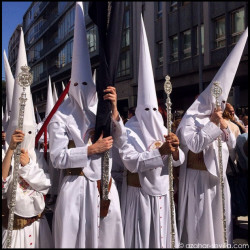
But what’s it all about? This is actually quite a complex question. The bare bones don’t seem too complicated. The processions are organised by rather more than forty brotherhoods (hermandades or cofradias) attached to the city’s churches and other religious institutions. The order of the processions during the week follows the events of the original, and each procession consists of at least one, usually two (a Christ and a Virgin), and occasionally three pasos (the floats bearing the religious figures), which are carried from their “homes” to the Cathedral to be blessed. The pasos are accompanied by penitents in traditional robes and hoods (every brotherhood has its own colours) to maintain their anonymity, marching bands, and the various officials who control the movement of the procession.

The origins go back to the 16th century, when the earliest, and simpler, processions made their way from Casa Pilatos (Pilate’s house) to the Cruz del Campo, the Cross in the Field (from which local brewer’s Cruzcampo take their name), but from 1604, by order of the Cardinal, they were obliged to pass through the Cathedral. The use of pasos began around the same time, and increased steadily through the 17th century, which was Seville’s Golden Age of artistic patronage. Then as now, the processions were organised by the hermandades, charitable and mutual aid organisations affiliated to particular churches and trades. At a deep level these were ritual expressions of a social solidarity that has not been entirely lost, even in the present day.

semana santa (1)costaleros taking a break

The floats are carried by teams of costaleros, who bear the weight on the backs of their necks, protected by a sack or costal wound around the head. Because the costaleros are hidden from view by curtains the floats appear to move by themselves (the costaleros are guided by a capataz with a code of taps with a hammer), often with a swaying motion that makes them seem almost alive. Some of the tight corners in the narrow streets are difficult to negotiate, and the costaleros practice the routes for weeks beforehand.

The floats and figures, some of which are important works of art in their own right, are richly decorated and often decked with flowers and candles. With the solemn files of penitents carrying crosses and long candles, and the distinctive music of the bands, the processions can be quite affecting, even for the non-religious, and this is especially true of the processions that go out overnight on Thursday to pass through the cathedral in the early hours of Good Friday.

semana santa (5)chairs stacked in front of La Campana

All the processions pass along the “Sacred Way” as they approach the Cathedral. This runs from La Campana, along Calle Sierpes, through the Plaza San Francisco, and up the Avenida de la Constitución. Terracing with seats (at a price) is provided for the spectators in the last two, and is highly prized for the views of the processions. It is sometimes said there are two types of Sevillanos – those who attend all the processions, and those who leave town for the week.

semana santa (3)

Not surprisingly with so many people coming into town for the week, hotel and apartment prices increase significantly, so if you’re on any sort of budget and aren’t coming for the religious festival, it may be best to plan your holiday for a different time. As well as that many bars, especially in the centre, will abandon tapas for the week in favour of raciones or a menu del día to improve efficiency.

With that said, however, spring is still the best time to come to Seville, as the weather is usually pleasantly warm and sunny, and the parks and gardens in full bloom. If you’re lucky you may be here when the orange blossom is out, filling the city with its perfume.  And Semana Santa in Seville is one of those unique events that you should try to experience once in your life.

photos courtesy of azahar-sevilla.com

Sevilla | NO8DO

As an observant visitor to our fair city of Seville, you may have noticed, on such diverse objects as lampposts, manhole covers, buildings and garbage trucks, among others, a little motif that seems to read NO8DO, except that the 8 is somewhat large, and often appears as if a little blurred. You may guess from its locations that it is some sort of official logo (it’s actually the city motto), and you may even have wondered what it means. Allow me to explain.

no8do 2

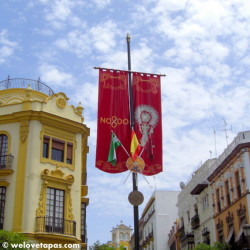
The motif is what is technically known as a rebus (a riddle or puzzle made up of letters, pictures and/or symbols whose names sound like the parts or syllables of a word or phrase). The central 8 represents a skein of wool, in Spanish “madeja”, and yields a phrase that sounds like no-madeja-do, and approximates the Spanish phrase “no me ha dejado” (the h is silent so it’s pretty close), which means “It (Sevilla) has not abandoned me”.

no8do flag

So why is this phrase the motto of the city? Thought you’d never ask. It all goes back to the 13th century (as so much does in these parts), and to the reign of Alfonso X, who succeeded to the throne of Castile and Leon (the castle and lion that you see on the heraldic shield of the Spanish kings) on the death of Ferdinand III, who reconquered Seville from the Moors, in 1252. Known as the Wise, this was more for his intellectual accomplishments than his statecraft, and he was often at odds with his nobles. He had two sons, Ferdinand (the elder) and Sancho. The times were troubled and turbulent, and in the course of one of the intermittent wars with the Moorish kingdom of Granada, Ferdinand was killed at the Battle of Ecija (1275).

no8do

Now Ferdinand had two young sons, and in the normal course of things the line of succession would have passed through them, but taking advantage of the fact that they were still children, Sancho invoked a principle known as Agnatic Seniority (basically this meant that the succession should pass to the younger son of the King (ie Sancho), and not to the children of the deceased older son. Alfonso backed the claim of Ferdinand’s children, the nobles backed Sancho, and civil war ensued. Most of the country was soon under Sancho’s control, but Seville remained loyal to Alfonso (they did not abandon him), and were granted the motto as a reward. Alfonso died in 1284 with the succession issue not officially resolved, although it was Sancho who in fact gained the throne.

So now that you know the story you will no doubt see NO8DO everywhere you go. And now you will know why.