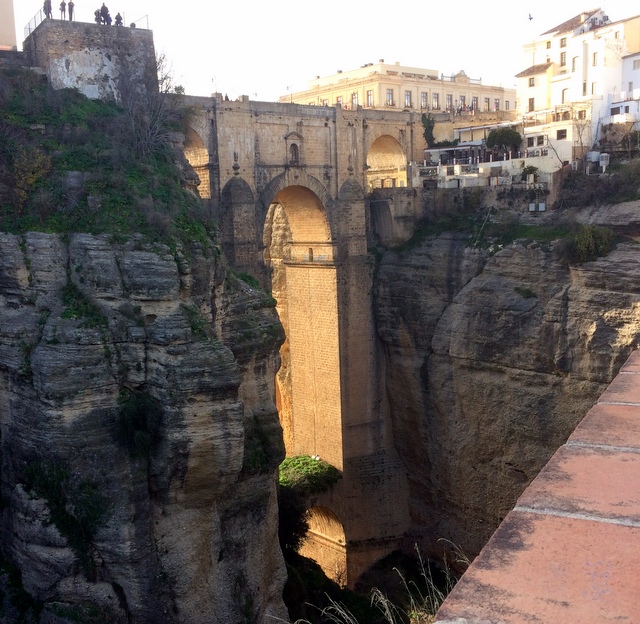
Ronda is one of our favourite small towns (population 35,000) in Andalucia, and is already a popular tourist destination. It’s situated in the mountains west of Malaga , between the Sierra de Grazalema and the Sierra de la Nieves, and is considered to be one of the “White Villages” of Andalucia. It can be reached quite easily by car or bus from Seville (about 2 hours) or Malaga.

The origins of modern Ronda go back to Roman times, but it’s during the Moorish era that it had it’s greatest fame and importance, even achieving independence for a time in the 11th century, and being one of the last Moorish strongholds to fall to the Christians (1485). It’s also regarded as the birthplace of modern bullfighting, pioneered by the Romero dynasty of bullfighters in the 18th century, and also (by a whisker) of Spain’s oldest bullring, completed in 1784. Both Ernest Hemingway and Orson Welles were great fans, but nowadays there are only a few days of bullfighting a year, during feria in the first week of September. The rest of the year it’s a major tourist attraction, and is well worth seeing.

Ronda’s main claim to fame, though, is its stunning hilltop location overlooking the area around – or more precisely two hilltop locations, separated by the Tajo Gorge, a spectacular narrow canyon up to 120 metres deep, with the River Guadalevín running through it. It’s spanned at its highest point by Ronda’s iconic Puente Nuevo (the New Bridge, actually built in the 18th century, but still called new to distinguish it from the older bridges lower down the hill). From here you can look out onto the valley to the west, or down the gorge, with its whitewashed houses perched on the edge, to the Puente Viejo (the Old Bridge, or Arab Bridge, actually built in the Christian era, though there was possibly a previous bridge on the same site) and the Puente Romano (the current structure is relatively modern, but again there are traces of earlier structures at the same place, certainly one from the Moorish period, and possibly from as early as Roman times). Walk down through the Cuenca gardens, visit the Baños Arabes (arab baths), and if you’re feeling fit go down the water mine, a stairway cut through the rock from the upper city down to the river.

At the north end of the bridge is the Christian period new town. As well as the bull ring there is the Alameda de Tajo, a small park at the top of the cliffs with spectacular views, and the churches of La Merced and El Socorro (time permitting).

To the south is La Ciudad, the old city, which has as many interesting things packed into its small area as pretty much anywhere in Spain. Must sees include the old main gate of the city, the Almocabar, with the fortified Church of the Holy Spirit, the old minaret and the central square the Plaza Duquesa de Parcent, where you can find the town hall and the Church of Santa Maria de la Mayor (sometimes referrred to as the cathedral, though it’s not the seat of a bishop). It’s also possible to walk down into the gorge for that classic shot of the New Bridge, and for a closer look at the remains of the old walls and mills. There are also several interesting museums, including the municipal museum in the Casa Mondragon, the House of Don Bosco, a small museum of wine and the Bandits Museum. My favourite, though, is the quirky and eclectic Lara Museum, which you should go and see.

Finally, where should you go to eat? There are plenty of good places, and any list based on the personal opinion of a visitor (even one who’s been a number of times) is necessarily incomplete, but this is my postcard, and this is my short list of places I like. For breakfast, Casa Luciano in the main street of the old town, where I was fortuitously led by a couple of locals on my last visit – great toast and coffee. Another new find was wood grilled meat restaurant El Sacristan, next to the Santa Maria church. Old favourites include La Niña Adela, which is at the top of the new town and a bit difficult to find, but worth the effort, the Almocabar (just outside the gate), and Tragatá, near the New Bridge and bullring.

Finally, a mention for Reservatauro, a bull and horse breeding farm just outside Ronda, where I spent a few fascinating hours learning about fighting bulls and Andalucian horses.


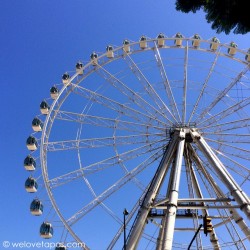
 Seville Wheel
 view from the Seville Wheel
 Malaga Wheel
 view of the Malaga Wheel from Muelle Uno