Day Trip to Triana

triana (56)

Typical Triana courtyard

Triana is the neighbourhood of Seville across the river from the old walled city, and is regarded by many Trianeros as a completely separate entity, historically, the home of Gypsies, sailors and other groups from the metaphorical wrong side of the tracks, and it retains something of that atmosphere today, with strong attachments to the cultures of flamenco and bullfighting, together with a certain religious fervour and sentimentality. If you’re in Seville for more than a couple of days and want to get away from the main tourist areas you should take some time to cross “The Bridge” to this near neighbour of the city.

triana (1)

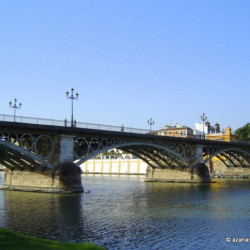
Isabel II bridge

The Bridge is the Isabel II bridge (popularly just called Triana bridge), a wonderful example of mid 19th century iron architecture which replaced the previous “bridge of boats”, built by the Moors in the 12th century. Crossing over you get some fine views along the river, on one side to the old port and the Torre del Oro, with the towers of the Plaza España beyond, as well as the old Moorish dock on the Triana side. In the other direction is the site of the 1992 expo and the Cartuja monastery.

triana (8)

Calle Betis from Plaza Altozano

The square immediately across the bridge, the Plaza Altozano, and the buildings around it, are still the hub of “old” Triana. The Restaurante El Faro on the left, beside the steps going down to Calle Betis, is an unmissable landmark. Much prettier, though, is the Carmen Chapel opposite, designed by Anibal Gonzalez in preparation for the 1929 Spanish American exhibition, with its brickwork and colourful tiles.

Before you begin exploring, grab a little breakfast at Manu Jara, a little French style patisserie on Calle Pureza with a tempting selection of croissants and pastries, as well as the obligatory coffee. Just opposite you can also find the Antigua Abacería, a traditional style pit stop that’s also worth a visit to whet your appetite.

triana (21)

Triana market stall

Then it’s back to the main square for a visit to Triana market, a must see for anyone with an interest in local food culture. With its old ceramic tile nameplates it’s probably the prettiest of Seville’s markets, as well as having all the traditional market produce, from colourful fruit and veg to fresh fish, hams, sausages, game, wonderful cheeses, and olives, beans and spices. There are also a number of market bars, both traditional and “gourmet”, including an oyster and sushi bar, and a microbrewery, which give you a good opportunity for a spot of refreshment and people watching.

triana (29)

Inquisition Alley

Beneath the market is a reminder of the Dark Side of Spain’s past, the Castillo San Jorge. Originally built to guard and defend the bridge of boats, it was for more than three centuries the Seville headquarters of the infamous Spanish Inquisition, and if you were unfortunate enough to be denounced for some real or imaged transgression this was where they brought you. The ruins are now a free museum, and though it’s quite grim (not a cushion or comfy chair to be seen) don’t expect lots of gore and sensationalism – just a reminder of where intolerance leads.

triana (32)

Ceramica Santa Ana

Behind the market is the old ceramics and pottery district. Even in Roman times Triana was famous for its pottery, and the martyred Sevillana saints Justina and Rufina were said to be potters from Triana. In the industrial age it was a major local activity, but now little remains except a few craft workshops, where you can pick up some nice colourful souvenirs. You can get a glimpse of former splendours with a visit to the Santa Ana Ceramics Museum, where you can see some of the old kilns, and examples of the work produced here.

Of course, you’ll be wanting to round off your day in one of Triana’s many busy tapas bars. Some of my favourites include Primero del Puente, a typical fried fish specialist opposite the Torre del Oro, Las Golondrinas on Pages del Corro (try the radishes. Seriously), and Sol y Sombra on Castillo.
Seville | Alternative Markets

Alternative shopping

At this time of year with Christmas just around the corner Seville city centre is crowded with shoppers looking for the best presents they can find. But how can we make our loved ones happy while still supporting local businesses? Actually, there are plenty of options and we’ve come up with this little guide to help you.

Craft Markets

mucho-mas-que-market

  • Mucho Maske Market
    This little craft market started up 9 years ago, and has been held in a variety of locations. This year it’s in the Regina area behind the Metropol Parasol (calle Viriato, 9) from the 17th until the 20th of December and will showcase 19 different brands, including jewellery and wooden toys.

12308556_1014598065268958_718657792021520578_n

  • El Butrón Market
    El Butrón is a cultural space where artists can meet and display their creations in temporary exhibitions. This is it’s 4th year, and it’s running from the 18th to the 20th of December at calle Butrón, 7, with workshops, music and organic food.

mercadoartesania

  • Mercado de Artesanía
    Organized by the Federación Artesanal de Sevilla and the City council Seville’s famous annual hadicraft market is already open in Plaza Nueva and will be there until the 5th of January, with a wide range of quality merchandise to choose from.

Shopping by Barrio

Captura de pantalla 2015-12-18 a las 15.03.57
Regina Market

The Regina market, actually an association of small local shops in Viriato, Jerónimo Hernández and Amparo streets, offers an individualistic style of shopping, with a mix of the moderni and the traditional. Some of the shops you can explore to find your presents are Un gato en bicicleta, La seta coqueta, Wabi Sabi, Un Globo or Pai-pai shop.

Captura de pantalla 2015-12-18 a las 15.34.11

Soho Benita
On the southern side of Las Setas we find another big area full of small fashion, design, and art places, together with some of the bars we visit in our tours and recommend in this blog. Spend a day in this neighbourhood and discover how Seville can be traditional and surprising at the same time. Soho Benita shops are Artefactum, Delimbo, Eirín, Florypondio, Isadora, La Importadora, Le Voilà, Patricia Buffuna, Taranta, Rayuela, Zález, Made with lof, Zapata and Verde Moscú, among others.

Feria/San Luis/Macarena
As well as “el Jueves” in calle Feria, the oldest flea market in Europe that takes place every Thursday morning, there are many handicraft workshops that have appeared in this neighbourhood in recent years.

  • La Osa Mallol
    A couple of years ago two great designers joined forces to share a space where they could create and sell their range of clothing, as well as teaching others how to do the same. Their names are Hisabelia and Loulitas and La Osa Mallol is their studio/atelier (Pasaje Mallol, 31). Whenever you go there they will offer you a cup of tea, but this weekend there will also be anisette and polvorones (Spanish Christmas’ shortbreads).315716_120518291442989_704227686_n
  • Desmontando a La Pili
    Diversity, feminism and responsible consumption are the name of the game here. So that you can be sustainable even in bed, Mónica Ortiz has come up with some options to make sex better. Her products, available through her website and her fantastic Tuppersex meetings, are designed for learning, solving problems and having fun. Give yourself or someone you love some pleasure and contact her at info@desmontandoalapili.com or find her at Tramallol (Pasaje Mallol, 22).12369190_425599504231584_7641245861606291842_n
  • Rompemoldes
    This is a group of workshops specialising in a variety of different crafts. Some are also shops where their products are sold, while others work on commission only basis. Located in a council owned building, this is a secluded space with a wonderful courtyard full of plants. Open the door (San Luis, 70) and sneak in, you won’t regret it!61444_129336633888982_1235443666_n
  • Lino y fino
    Petra started creating and selling handmade linen clothes in Tarifa, near Cadiz, in 1998. She now has two more shops, and we are lucky to have one at calle San Luis, 72. She uses 100% pure linen for unique women’s, men’s and children’s clothes. She also uses some warmer fabrics for winter!10639723_765154423569614_5246665074246108001_n
  • Santa Cleta
    There are many bike shops in Seville, a result of growing interest in green transport options, but the most sustainable, committed and active one is Santa Cleta. They won’t only sell you a bike, but will also teach you how to ride it, no matter what your age, and how to maintain and repair it! Ride, or walk, to Plaza del Pumarejo and take the street on the right hand side of the old palace: Fray Diego de Cádiz, 24.1000779_553683444691065_347742336_n


Remember: Think global, shop local and buy handmade.