
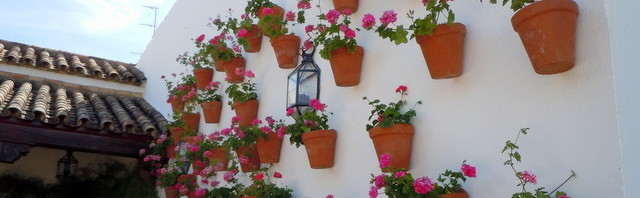
Typical Triana courtyard
Triana is the neighbourhood of Seville across the river from the old walled city, and is regarded by many Trianeros as a completely separate entity, historically, the home of Gypsies, sailors and other groups from the metaphorical wrong side of the tracks, and it retains something of that atmosphere today, with strong attachments to the cultures of flamenco and bullfighting, together with a certain religious fervour and sentimentality. If you’re in Seville for more than a couple of days and want to get away from the main tourist areas you should take some time to cross “The Bridge” to this near neighbour of the city.

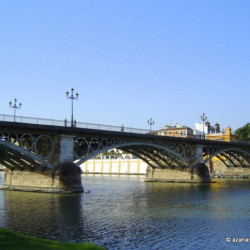
Isabel II bridge
The Bridge is the Isabel II bridge (popularly just called Triana bridge), a wonderful example of mid 19th century iron architecture which replaced the previous “bridge of boats”, built by the Moors in the 12th century. Crossing over you get some fine views along the river, on one side to the old port and the Torre del Oro, with the towers of the Plaza España beyond, as well as the old Moorish dock on the Triana side. In the other direction is the site of the 1992 expo and the Cartuja monastery.

Calle Betis from Plaza Altozano
The square immediately across the bridge, the Plaza Altozano, and the buildings around it, are still the hub of “old” Triana. The Restaurante El Faro on the left, beside the steps going down to Calle Betis, is an unmissable landmark. Much prettier, though, is the Carmen Chapel opposite, designed by Anibal Gonzalez in preparation for the 1929 Spanish American exhibition, with its brickwork and colourful tiles.
Before you begin exploring, grab a little breakfast at Manu Jara, a little French style patisserie on Calle Pureza with a tempting selection of croissants and pastries, as well as the obligatory coffee. Just opposite you can also find the Antigua Abacería, a traditional style pit stop that’s also worth a visit to whet your appetite.

Triana market stall
Then it’s back to the main square for a visit to Triana market, a must see for anyone with an interest in local food culture. With its old ceramic tile nameplates it’s probably the prettiest of Seville’s markets, as well as having all the traditional market produce, from colourful fruit and veg to fresh fish, hams, sausages, game, wonderful cheeses, and olives, beans and spices. There are also a number of market bars, both traditional and “gourmet”, including an oyster and sushi bar, and a microbrewery, which give you a good opportunity for a spot of refreshment and people watching.

Inquisition Alley
Beneath the market is a reminder of the Dark Side of Spain’s past, the Castillo San Jorge. Originally built to guard and defend the bridge of boats, it was for more than three centuries the Seville headquarters of the infamous Spanish Inquisition, and if you were unfortunate enough to be denounced for some real or imaged transgression this was where they brought you. The ruins are now a free museum, and though it’s quite grim (not a cushion or comfy chair to be seen) don’t expect lots of gore and sensationalism – just a reminder of where intolerance leads.

Ceramica Santa Ana
Behind the market is the old ceramics and pottery district. Even in Roman times Triana was famous for its pottery, and the martyred Sevillana saints Justina and Rufina were said to be potters from Triana. In the industrial age it was a major local activity, but now little remains except a few craft workshops, where you can pick up some nice colourful souvenirs. You can get a glimpse of former splendours with a visit to the Santa Ana Ceramics Museum, where you can see some of the old kilns, and examples of the work produced here.
Of course, you’ll be wanting to round off your day in one of Triana’s many busy tapas bars. Some of my favourites include Primero del Puente, a typical fried fish specialist opposite the Torre del Oro, Las Golondrinas on Pages del Corro (try the radishes. Seriously), and Sol y Sombra on Castillo.


 Cordoba is the home of salmorejo, the thick tomato soup often served with a garnish of hard boiled egg and jamón, of the flamenquín (rolled pork and cheese fried in a coating of breadcrumbs), and of fried aubergine/eggplant with a dressing of cane sugar molasses. You can also find the biggest tortillas de patatas in the world, available from